
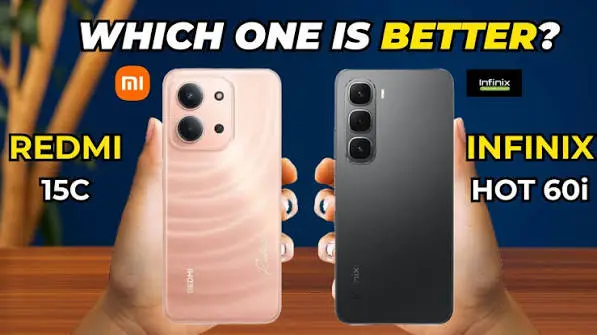
Redmi 15C vs Infinix Hot 60i: Almost Twins, One Key Trade-Off
On this page 10 sections
Rarely do two phones in Nepal share as much on paper as the Redmi 15C and Infinix Hot 60i. Same chipset, same display size and refresh rate, similar camera resolution, similar price — on a spec sheet, they look nearly identical. But look closer and a genuine trade-off emerges: bigger battery versus faster charging versus a video feature neither rival in this price range can match. Here’s what actually separates two phones that, at first glance, don’t seem to differ at all.
Quick Verdict
Choose the Redmi 15C if: all-day (or two-day) battery life is your top priority — its 6000mAh cell is among the largest at this price point in Nepal, and Xiaomi’s wide service network adds peace of mind.
Choose the Infinix Hot 60i if: you’d rather charge fast than carry a bigger battery, and you actually record video — its QHD recording capability is genuinely rare to find this cheap.
Specifications at a Glance
| Spec | Redmi 15C | Infinix Hot 60i |
|---|---|---|
| Display | 6.9″ IPS LCD, 120Hz, HD+ | 6.9″-class LCD, 120Hz — very similar panel specs to the Redmi |
| Chipset | MediaTek Helio G81 Ultra | MediaTek Helio G81 (same family) |
| RAM / Storage | 4/128GB, 6/128GB, or 8/256GB | Comparable tiers available |
| Camera | Similar resolution to the Infinix — check current listings for the exact MP count on your preferred variant | Similar resolution to the Redmi, plus QHD (1440p) video recording |
| Battery | 6000mAh | Smaller capacity than the Redmi |
| Charging | 33W wired | 45W wired |
| Build | IP64 rated, one-handed use is a stretch given the size | Similar large-screen form factor |
| Price in Nepal | Rs. 16,999 (4/128GB) – Rs. 21,999 (8/256GB) | Rs. 16,999 – Rs. 21,999 (similar tiers) |
Both phones sit right around the Rs. 15,000-20,000 line and have shifted with recent price revisions — confirm exact current pricing and camera specs for your preferred variant before publishing or buying. See live listings: Redmi 15C price in Nepal · Infinix Hot 60i price in Nepal
The Same-Chipset Question
Both phones run on MediaTek’s Helio G81 family, which explains why day-to-day performance — browsing, social media, calls, casual gaming — feels nearly identical between them. Neither is built for demanding games, and neither pretends otherwise; this is a chipset tier built for reliability at a low price, not benchmark scores.
Because the core hardware is this close, the actual buying decision comes down almost entirely to the handful of areas where the two genuinely diverge — battery capacity, charging speed, and video recording — rather than any difference in raw performance.
Battery vs Charging: Pick Your Trade-Off
This is the clearest, most practical difference between the two. The Redmi 15C’s 6000mAh battery is genuinely large for this price bracket — the kind of capacity that gets you through a heavy day of use without hunting for a charger, or a light day and a half without one.
The Infinix Hot 60i trades some of that raw capacity for notably faster 45W charging versus the Redmi’s 33W. In practice, this means shorter waits when you do need to charge, even if you’re reaching for the charger somewhat more often over the course of a week. Neither approach is objectively better — it depends whether you’d rather charge less often or charge faster when you do.
Video Recording: A Real Gap at This Price
The Infinix Hot 60i’s QHD (1440p) video recording is a genuine standout — research into this segment consistently notes it as a feature no direct rival at this price point offers. If you record video for social media, family moments, or anything beyond the occasional clip, this is a real, tangible advantage that the Redmi 15C doesn’t match at this price tier.
For photos specifically, the two are close enough in resolution that day-to-day shooting won’t reveal a dramatic gap — the difference shows up in video, not stills.
Build and Everyday Handling
Both phones use a large-format display — the kind of 6.9-inch-class screen that’s great for video and browsing but genuinely difficult to use one-handed. If you want a phone you can comfortably operate with one thumb, neither of these is the right pick; both are built around screen size as a selling point, not pocketability.
The Redmi 15C carries an IP64 rating, offering meaningful protection against dust and light splashes — a small but genuine safety net for Nepal’s monsoon season that’s worth checking for on the Infinix as well before you decide, since official ratings can vary by exact model and market batch.
Buying Tips Specific to This Price Tier
At the Rs. 15,000-20,000 level, a few practical checks matter more than they do further up the price ladder. Confirm the phone has proper NTA (Nepal Telecommunications Authority) MDM pre-registration before buying — this affects whether the phone’s IMEI is recognised on Nepali networks, and budget-tier grey imports are more likely to skip this step than phones from established authorised distributors.
Warranty length is also worth comparing directly rather than assuming — some budget phones in this segment come with a 2-year warranty while others offer just 1 year, and that difference matters more the longer you plan to keep the phone. Ask specifically rather than assuming parity between brands.
Who Should Actually Buy Each One?
The heavy daily user who hates charging often: the Redmi 15C’s 6000mAh battery is the more comfortable choice — set it and forget it until evening, most days.
The person who records a lot of video for social media: the Infinix Hot 60i’s QHD recording is a genuine, rare capability at this price — a clear reason to pick it even with a smaller battery.
Someone who’s always rushing and charges in short bursts: the Infinix’s 45W charging fits a grab-and-go lifestyle better than waiting on the Redmi’s 33W.
A first phone for a student or parent, bought for reliability above all: the Redmi 15C’s bigger battery and Xiaomi’s wide service presence in Nepal make it the lower-maintenance choice for someone who won’t fuss over charging habits.
Frequently Asked Questions
Since these two phones are so similar, does the brand name matter at all?
Beyond the specific hardware differences covered here, brand does matter for warranty support and how easy it is to find an authorised service centre — Xiaomi has traditionally had one of the widest distribution and service networks in Nepal, worth weighing if after-sales support matters to you.
Is a 6.9-inch phone practical for everyday one-handed use?
Not really — phones this size are built for people who prioritise screen real estate for video and browsing over pocket-friendliness or one-handed operation. If compact size matters more to you, look at smaller-screened options even if that means a step down elsewhere.
Is the Helio G81 chipset good enough for light gaming?
Yes, for casual and light gaming it handles the job fine. It’s not built for demanding, graphics-heavy titles at high settings — for that, you’d need to look at a higher price tier with a more powerful chipset.
Why do these two phones keep getting compared to each other specifically?
Because they’re genuinely unusual in how closely matched they are — same chipset family, same screen class, similar camera resolution, and overlapping prices. It’s a rare case where the spec sheets alone don’t make the decision for you.
Should I wait for prices to drop, or buy now?
Component costs have been rising industry-wide through 2026 due to the global RAM shortage, so waiting doesn’t reliably mean a lower price — if either phone meets your needs today, there’s little advantage in delaying the purchase.
Want the full spec sheet and live prices side by side? Redmi 15C · Infinix Hot 60i
Continue researching cameras
Move from editorial context into recorded Nepal prices, buying guides and comparison tools.



Be the first to share your thoughts!
No comments yet. Your thoughts matter.